
Scapex / Services / Shopify SEO
Shopify SEO services
A Shopify SEO agency for D2C and export brands — collection architecture, duplicate product URLs, faceted navigation and product schema.

Shopify is capable, with known constraints
The fundamentals are handled well out of the box: speed, mobile rendering, SSL, sitemaps. What Shopify does not handle well is URL structure, and that is where most Shopify SEO work actually happens.
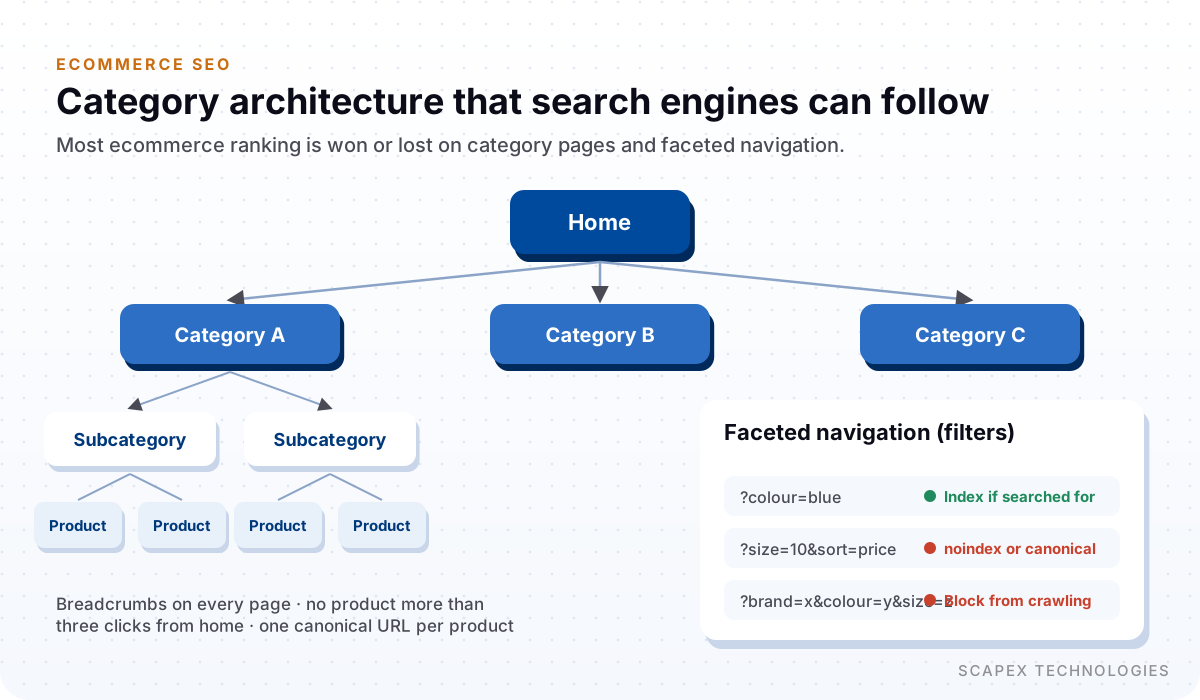
Every product is reachable at two paths — through its collection and standalone — which creates duplicate routes to the same page. The /collections/ and /products/ prefixes cannot be removed. Pagination and filtering generate crawlable URLs at scale. None of this is fatal, and all of it has established fixes, but it has to be done deliberately.
What we change
Canonical strategy across the collection and product duplication. Collection pages given real content rather than a grid with a title. Faceted navigation constrained so filters stop generating thousands of thin indexable URLs. Product, Offer and AggregateRating schema implemented correctly — which also makes your products citable when an assistant compares options.
For exporters, hreflang and market-level keyword research on top, because Shopify's multi-market setup is easy to get subtly wrong.
Where the volume actually is
'Shopify SEO' draws 590 searches a month in India at a difficulty of 65 — a competitive term. The parent category, 'ecommerce SEO', draws 1,300 at difficulty 57. For most stores the realistic entry is not either of those but the product and category terms your buyers search, which is where a well-built catalogue wins quietly.
Where Shopify sites lose search traffic
Duplicate product URLs. Shopify serves the same product at /products/item and /collections/anything/products/item. The canonical usually handles it, but themes and apps routinely link internally to the collection-scoped version, which spreads the internal signals across two addresses instead of one.
Filter and sort parameters. Faceted navigation generates a large number of near-identical URLs. Left crawlable, they consume the crawl budget that should be reaching your actual collection and product pages — the same “discovered, not indexed” pattern that starves new stores.
Thin collection pages. A collection page with a title and a grid of products has nothing for a search engine to rank on a commercial query. Collections are the pages that should rank for category terms, and on most stores they are the emptiest pages on the site.
App accumulation. Every installed app injects script. Reviews, pop-ups, upsells, chat and analytics together are usually the reason a Shopify store fails Interaction to Next Paint on mobile.
Product schema that lies. Review markup on products with no reviews, or price and availability that drift out of date, is a manual-action risk rather than a rich-result opportunity.
Why the platform term beats the category term
There is a 38-point difficulty gap hiding inside two phrases that mean almost the same thing to a buyer. Measured in Semrush on 25 September 2026: “shopify seo agency” draws 3,600 searches a month in the United States at a difficulty of 14; “ecommerce seo agency” draws 6,600 at a difficulty of 52. The second has roughly twice the volume and is, for any site without a long-built link profile, effectively closed.
The same pattern holds in the United Kingdom, where the Shopify term draws 2,400 a month, and in Australia at 1,000. A store owner searching either phrase wants the same thing. The difference is that the generic category term has been fought over by large agencies for a decade, and the platform-specific one has not.
That is the whole argument for naming the platform rather than the category: not that it is a smaller ambition, but that it is the same buyer reached through a door that is still open. The work on the page is identical either way — catalogue architecture, duplicate product URLs, faceted navigation, product schema.
Common questions
Is Shopify good for SEO?
Yes, with caveats. Core technical performance is strong by default. The constraints are URL structure — duplicate product paths, immovable /collections/ and /products/ prefixes — and limited control over some directives. All are workable; none should stop you choosing Shopify.
Why are my Shopify products not ranking?
The three usual causes are duplicate product URLs splitting authority between collection and standalone paths, collection pages with no unique content, and filter-generated URLs consuming crawl budget. A crawl will tell you which one applies within a day.
Do you work with Shopify Plus?
Yes. Plus mainly changes what is technically possible — more control over checkout, scripts and multi-store setups — rather than changing the underlying SEO approach.
Start with the audit
Send a URL and get a written read of your technical health, your AI-answer visibility and the three things worth fixing first.
Related