
Scapex / Services / Programmatic SEO
Programmatic SEO
A programmatic SEO agency building pages from real data at scale — with the quality gate that stops them becoming doorway pages.

Scale is not the problem, sameness is
'Programmatic SEO' draws 720 searches a month in India at difficulty 53, and most of what is published under the name earns a manual action eventually.
Generating pages at scale does not violate any guideline. Generating substantially similar pages with no independent value does. The distinction is whether each page answers a distinct query with genuinely different information, and it is a test you can apply yourself: swap one variable, and if the page still reads identically, it should not exist.
Where it legitimately works
Product catalogues where each item has real differing specifications. Comparison and integration pages where the compared items genuinely differ. Lane, route and coverage pages where transit times, documentation and restrictions actually vary. Data-driven pages built on a dataset you own and nobody else has published.
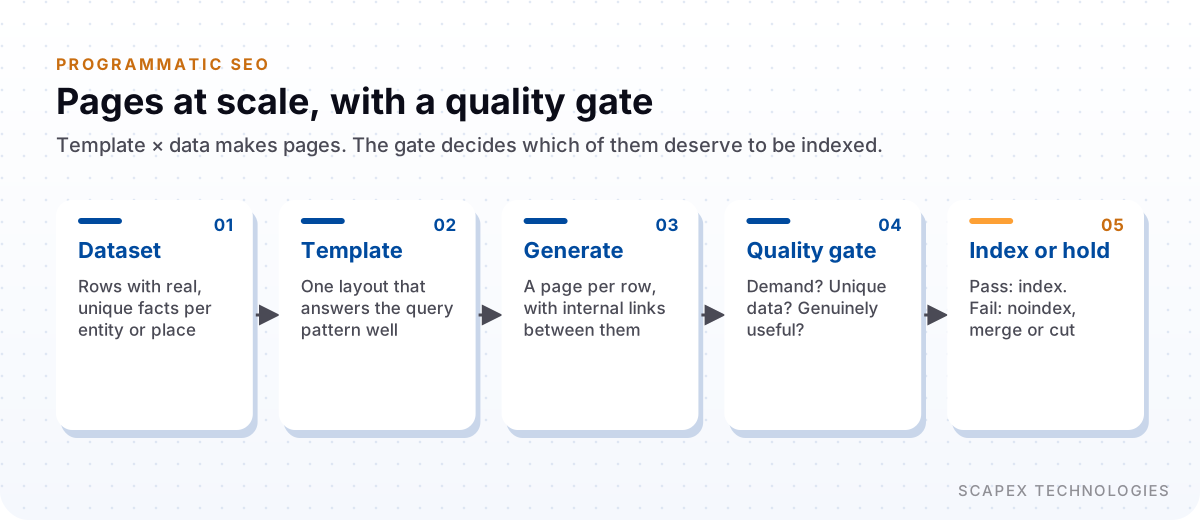
We build the template, the data model, and — most importantly — the quality gate: a rule that refuses to publish a page below a threshold of unique content. Ten thousand pages with no gate is a liability; two thousand with one is an asset.
Programmatic pages that survive, and the ones that get filtered
Generating thousands of pages from a template and a spreadsheet works when each page carries data nobody else has assembled, and fails when it carries a rearranged sentence. The distinction is not page count or intent; it is whether removing the template leaves anything behind.
Pages that hold up are built on a real dataset: availability, specifications, prices, timetables, compatibility, coverage, regulations by jurisdiction. Somebody has to maintain the data, and the maintenance is the actual product. Pages that get filtered are permutations of two variables — service plus city, product plus adjective — with a paragraph spun around them, and they are now filtered quickly and at scale.
Three checks before building anything at volume. Does each page answer a question a person actually asks, evidenced by demand data rather than by the fact that the combination exists? Would a reader who landed on one page find something on it they could not get from the page next door? And can the set be kept accurate — because a programmatic set that goes stale becomes thousands of pages of wrong information, which is worse than not having built it.
We also set an indexation policy at the start rather than after launch. Publishing the long tail and letting search engines sort it out is how sites acquire a crawl problem that takes months to unwind.
A small term, and an unusually open one
Measured in Semrush on 25 September 2026: “programmatic seo agency” draws 210 searches a month in the United States at a keyword difficulty of 9, with a cost per click of $18.97. It is one of the few terms in this field that Semrush classifies as commercial rather than informational — the people typing it are looking to hire, not to read.
Two hundred searches is a small number and we are not going to dress it up. But 210 commercial-intent searches at difficulty 9, against “programmatic seo” in India at 720 and difficulty 53, is a better use of a page than chasing the larger, harder term. Low-volume high-intent demand is exactly the shape of work this service suits.
It is also the term where the quality gate matters most. Programmatic SEO done without one produces the doorway pages Google has spent years removing, and an agency that will not talk about the gate before the templates is selling the wrong half of the service.
Common questions
Is programmatic SEO safe?
It is safe when each generated page carries genuinely distinct, useful information and unsafe when it does not. The guideline being tested is scaled content abuse, which turns on independent value rather than on whether a template was used.
How many pages can we generate?
As many as you have genuinely differentiated data for, and not one more. The constraint is your dataset, not the technology. If you have specifications for two thousand products, you have two thousand legitimate pages; if you have one description reused with the city changed, you have one.
Start with the audit
Send a URL and get a written read of your technical health, your AI-answer visibility and the three things worth fixing first.
Related