
Scapex / Services / Google Ads management
Google Ads agency and management
Search, Performance Max, Shopping and remarketing managed against your organic keyword map. 301,000 searches a month in India.

The most expensive keyword we measured
'Google Ads' draws 301,000 searches a month in India at a keyword difficulty of 88 — one of the most contested terms across the 1,966 keywords we mapped. That is agencies bidding against agencies, and it tells you how crowded this service category is.
It also tells you something useful about your own account: in a market this crowded, bidding harder is rarely the answer. Conversion rate and account structure almost always are.
What we manage inside the account
Search campaigns structured by intent rather than by product hierarchy, because match types and negatives do more for efficiency than bid tweaking. Performance Max with proper asset groups and exclusions, rather than as a black box handed the whole budget. Shopping, where feed quality is usually the binding constraint — missing GTINs, weak titles and no product-type taxonomy cap performance regardless of bidding.
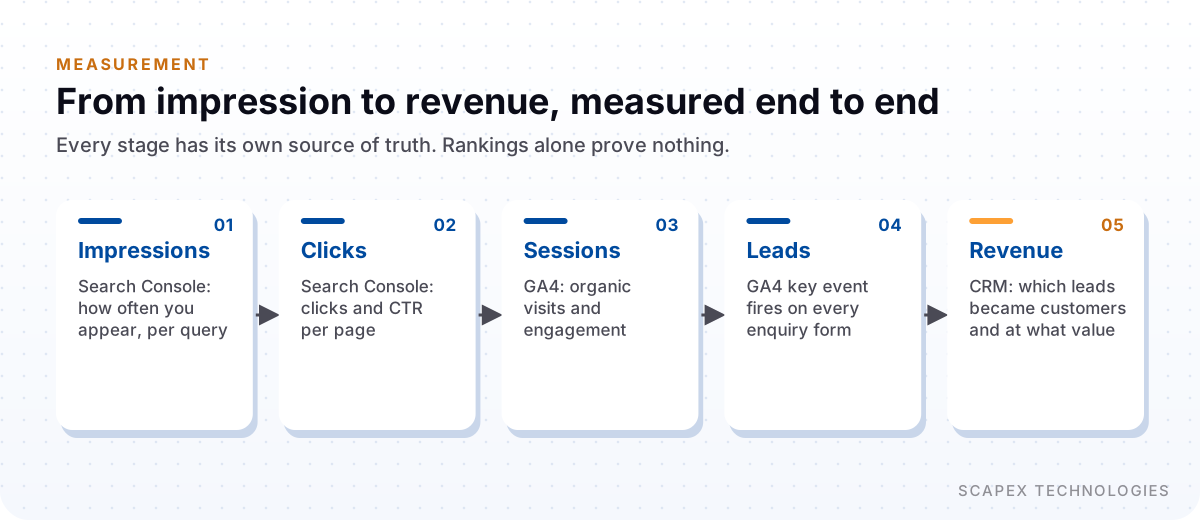
Remarketing segmented by what the visitor actually did, and conversion tracking verified end to end before anything is optimised, because optimising against a broken conversion signal makes the account worse every day it runs.
Where the paid-search demand actually sits
The phrase most agencies optimise for is not the one buyers use. Measured this week:
| Keyword | Searches / month | Difficulty |
|---|---|---|
| google ads agency | 1,300 | 22% |
| ppc services in india | 1,000 | 35% |
| ppc management services india | 880 | 26% |
| ppc services | 590 | 45% |
| google shopping ads agency | 390 | 16% |
| google ads management services | 390 | 17% |
| google ads agency near me | 390 | 9% |
“google ads services” draws more searches than any of these at 1,600 a month, but at difficulty 49 and with a large share of the results being Google’s own documentation and local-services listings. The soft commercial terms are the agency and management phrasings, at difficulty 17 to 26.
The first thirty days on an account
Week one is measurement, not optimisation. The first thing we check is whether the conversions in the account are real. The two faults we find most often are a conversion firing on page load rather than on submission, and the same lead counted by both a tag and an import — both of which make every optimisation decision afterwards wrong in the same direction.
Then the search terms report. Broad match plus Smart Bidding on a small budget reliably spends it on terms with no purchase intent. We read the actual queries, build the negative list from them, and only then look at bids.
Then concentration. Most small accounts are spread across more campaigns than the budget can feed. A campaign that cannot accumulate around fifty conversions a month cannot support automated bidding, which is the usual reason performance looks random.
And the landing page. Paid traffic exposes a weak page faster than organic does, because it arrives at scale on the day you switch it on.
Paid and organic run off one keyword map here. Paid data settles in weeks what organic testing takes a year to learn: which phrasing converts, which does not, and which terms are worth the organic investment at all.
Common questions
How do you decide whether a Google Ads campaign is working?
By cost per acquisition against your margin, not by clicks or impressions. Before anything is scaled we make sure conversions are tracked properly — calls, forms and sales — because a campaign that looks busy in the dashboard can still lose money on every customer it brings in. A campaign earns more budget only once the tracking shows each customer costs less than they are worth.
Is Performance Max worth using?
Often yes for ecommerce with a clean feed, and frequently not for lead generation without careful exclusions and good conversion data. Its weakness is opacity: given poor signals it will confidently spend the budget on the wrong audience.
Start with the audit
Send a URL and get a written read of your technical health, your AI-answer visibility and the three things worth fixing first.
Related