
Scapex / Services / Technical SEO
Technical SEO
A technical SEO audit service covering crawl, indexation, rendering, Core Web Vitals, schema and log-file analysis — the foundations every other SEO investment compounds on.

The constraint nobody wants to look at
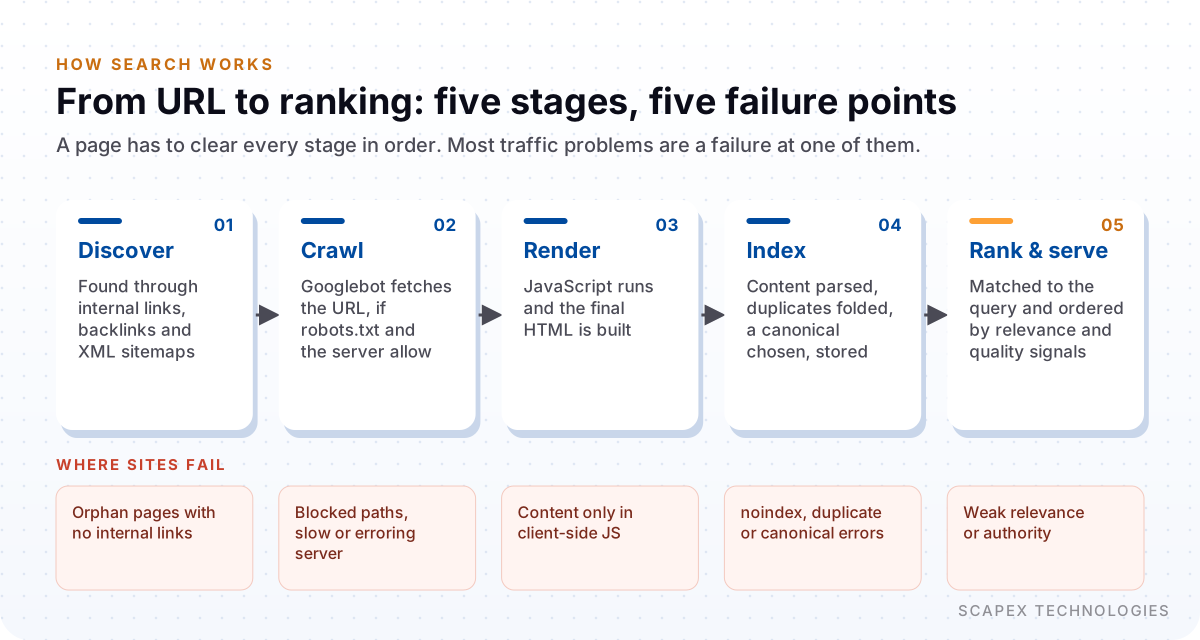
Most underperforming sites do not have a content problem. They have a crawl, indexation or rendering problem that content spend cannot fix, and the symptom looks identical from the outside: traffic that will not move.
Technical SEO is the work of finding the binding constraint and removing it. It is the least visible part of the discipline and consistently the highest return, because it releases value the site has already earned but cannot express.
What we examine
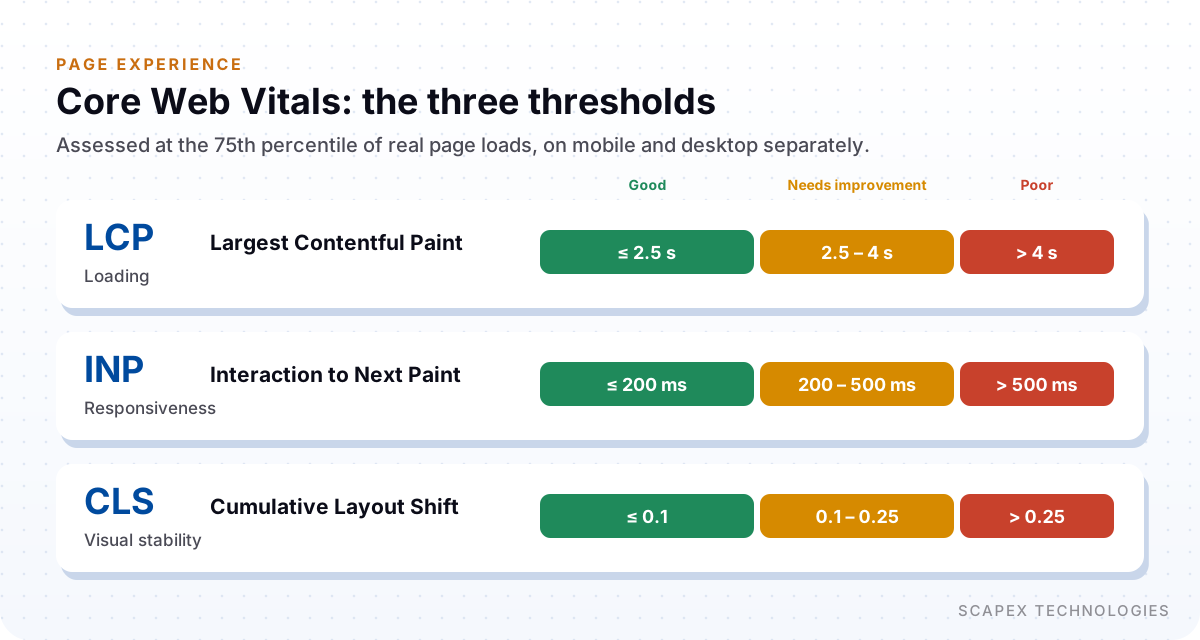
Crawl budget and log files — what search engines actually request, how often, and what they ignore. Indexation and canonicalisation. JavaScript rendering, which is where a surprising number of sites lose their content entirely. Core Web Vitals and real-user performance data. Internal link structure and depth. Structured data. Hreflang for international sites. Redirect chains and legacy migration debris.
Migrations
Replatforming, redesigning or changing domain is the single most dangerous thing a site can do to its organic traffic, and it is routinely handled as an afterthought. We map, redirect and validate before launch rather than diagnosing the drop after it. Search volume for 'SEO migration' is negligible, which is exactly why it goes wrong so often — nobody looks for the service until they need it retroactively.
Platform notes: Magento, BigCommerce, Drupal, Webflow
Each platform fails in its own characteristic way, and most technical SEO work is undoing a platform default. These four used to be separate pages; in India they draw between 20 and 90 searches a month each, so they read better here, where the buyer who needs them will actually find them.
Magento
Magento is the most capable ecommerce platform we work on and the easiest to cripple. It gives you full control over URLs, canonicals and indexation, which means every one of those is your responsibility rather than a sensible default. Three problems account for most of what we find. Layered navigation generating crawlable URLs for every filter combination, which on a large catalogue means hundreds of thousands of thin pages. URL rewrite tables accumulating years of stale redirects that slow every request. And category-product URL duplication where the same product is reachable through every category path it belongs to.
Robots and canonical rules on layered navigation, then a crawl to confirm the filter URLs have actually stopped being requested. Cleaning the rewrite table, which frequently produces a measurable speed gain on its own. Setting a single canonical product URL pattern. Then full-page caching and image handling, because Magento's Core Web Vitals problems are almost always infrastructure rather than code.
BigCommerce
Big Commerce handles more of the technical groundwork than Magento or Woo Commerce — clean URLs, automatic sitemaps, sensible canonicals, decent performance without infrastructure work. For a mid-sized catalogue that removes most of the common failure modes before you start. The trade is control. Where you hit a structural limit — URL patterns, some redirect behaviour, template-level markup — there is frequently no way around it short of going headless.
Faceted search configuration, which is the one place Big Commerce will happily generate crawlable combinations. Category content, since the default category template is a grid with a title and that is where commercial intent lands. Product schema beyond what the platform emits by default. And for stores that have outgrown the ceiling, a headless build with Big Commerce as the commerce engine, which restores full control at the cost of needing a development team.
Drupal
Drupal survives in enterprise, government, education and large multilingual publishing because of things most platforms handle badly: genuinely deep taxonomy, granular access control, and multilingual content modelling that treats translations as first-class rather than as a plugin. For an Indian exporter running six language versions with different content per market, that last point is not a minor convenience — it is the reason to be on Drupal at all.
Module sprawl, where three modules touch metadata and write competing tags. Taxonomy generating thousands of indexable term pages that nobody intended and nobody noindexed. Path alias configuration producing duplicate routes to the same node. And caching misconfigured to the point where anonymous visitors get slow uncached responses while the team sees a fast site. Our first pass on a Drupal site is almost always an inventory: which modules affect output, what they each write, and which of them can be removed.
Webflow
Webflow gives you what the other visual builders withhold: complete control over markup, heading structure, URL patterns and custom attributes, on static hosting that is fast without infrastructure work. For a marketing site it is close to ideal. The output is clean, the rendering is static so crawlers see everything immediately, and performance is good by default rather than after optimisation.
CMS collection item limits, which arrive sooner than people expect on content-heavy sites and force a plan change or an architecture rethink mid-project. Nested collection constraints, which make some content models — a taxonomy several levels deep — awkward or impossible without workarounds. And 301 redirect management, which exists but is manual, so a large migration into Webflow needs the redirect map prepared carefully rather than assembled in the UI afterwards.
The audit term is the reachable one
Measured in Semrush on 25 September 2026: “technical seo” sits at a difficulty of 66 — a term contested by every major agency and most SEO software companies. “technical seo audit service” draws 3,600 searches a month in the United States at a difficulty of 19, with a cost per click of $13.79. The United Kingdom adds 1,300, Australia 590, Canada 320.
The head term attracts practitioners reading up on their own craft. The audit term attracts someone who has decided they need the work done and is looking for whoever does it. Those are not the same person, and only one of them becomes a client.
It is the clearest example on this site of a rule worth stating outright: the phrase that describes the deliverable is almost always easier to rank for, and worth more, than the phrase that names the discipline.
Common questions
What is included in a technical SEO audit?
A full crawl of the site, log-file analysis where server logs are available, indexation and canonical review, JavaScript rendering checks, Core Web Vitals and field performance data, internal linking and crawl-depth analysis, structured data validation, and for international sites an hreflang review. The output is a prioritised list ordered by impact against effort, not an automated tool export.
How often should technical SEO be reviewed?
A full audit annually, or immediately before and after any migration, replatform or major redesign. Beyond that, continuous monitoring of indexation and Core Web Vitals catches most regressions early. Sites that deploy frequently need tighter monitoring, because most technical SEO damage arrives as a side effect of a release nobody thought was SEO-relevant.
Can technical SEO fix a traffic drop?
Often, yes — if the drop was caused by a technical change rather than an algorithm update or a competitor improvement. The first job is diagnosis: matching the date of the drop against deployment history, algorithm update timelines and index coverage data. Fixing the wrong cause is expensive, so we do not start work until the cause is established.
Start with the audit
Send a URL and get a written read of your technical health, your AI-answer visibility and the three things worth fixing first.
Related