
How to appear in Google AI Overviews
A practical checklist for getting your pages cited in AI Overviews — what triggers them, what gets selected, and the five changes that move the odds.

Start with what an Overview actually is
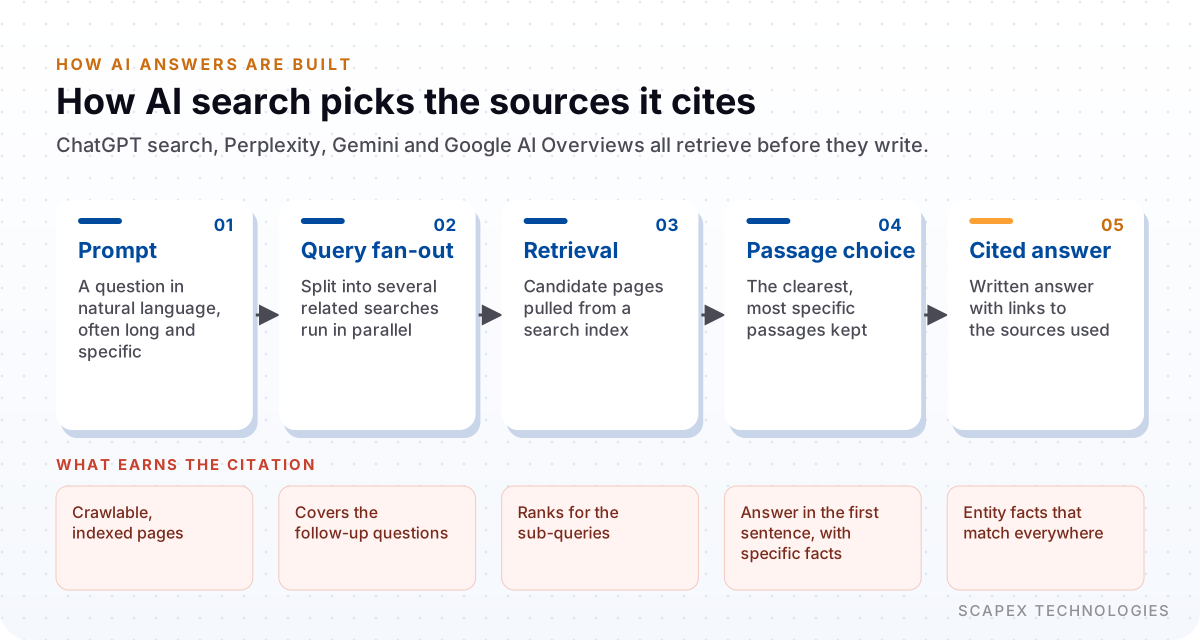
An AI Overview is a synthesised answer Google places above the classic results, assembled from pages it has already indexed and ranked. That last part matters more than anything else in this article: Overviews do not draw from a separate universe of content. They draw from the index. If your page cannot rank, it cannot be cited.
So the first and least glamorous answer to 'how do I appear in AI Overviews' is that you must first be capable of appearing in ordinary results for the same query. Everything below assumes that groundwork exists.
Which queries trigger one, and which do not
Overviews appear disproportionately on informational and comparative queries — how something works, what the difference is between two things, what the options are. They appear far less on navigational queries and on transactional ones where Google has a commercial surface to show instead.
This has a direct planning consequence. If your money pages target 'buy X in Ahmedabad', Overviews are largely not your battleground and you should not rebuild those pages around them. If your category involves buyers researching before they commit — which describes most B2B, industrial and professional services — Overviews sit directly across the top of the research phase.
What gets selected
Google has not published a ranking system for citations, and anyone claiming to know one precisely is guessing. What is observable, consistently, is that cited passages share a set of characteristics.
They answer one question completely, inside a single passage, without depending on the paragraph before or after. They state something specific — a number, a threshold, a date, a named standard — rather than describing a capability in adjectives. They come from pages whose subject is unambiguous, where the entity being discussed is clearly identified. And they sit on pages that already had reason to rank.
The inverse is equally consistent. Marketing prose that takes three paragraphs to reach a claim, hedges it, and never states a figure is almost never quoted, however well it ranks.
Five changes that move the odds
First, restructure your key pages so that each section opens with a direct answer of roughly forty to sixty words, then expands. This single change does more than everything else combined, and it costs nothing but editing.
Second, put your facts in text. Specifications inside a PDF catalogue, prices inside an image, capacities inside a video — none of it is available for citation. Extract it onto the page.
Third, implement schema properly. FAQPage, HowTo, Product and Organization markup do not force a citation, but they remove ambiguity about what your page is asserting, and ambiguity is the most common reason a page is skipped.
Fourth, make your entity consistent. Your business name, address, description and category should be identical on your site, in your structured data, in your Google Business Profile and in every directory that lists you. Conflicting descriptions of who you are make a model less willing to name you.
Fifth, get into the third-party sources that are already being cited. For many queries the Overview draws on a listicle, a directory or an industry publication rather than a vendor site. Being added to a source Google already trusts is frequently faster than making your own page the source.
Measuring it honestly
Overview citations are not a ranking and should not be tracked like one. Build a fixed set of prompts that represent how your buyers actually ask, check them at intervals across Google, and record whether you are named, who else is, and which sources are cited. Read it as a trend across months, because the outputs vary between sessions and between users.
And expect your click-through rate on informational queries to fall even as visibility rises. That is the trade the format imposes. Track branded search volume and direct enquiries alongside sessions, or you will conclude the work is failing when it is working.
What not to do
Do not build pages whose only purpose is to be quoted. Thin question-and-answer pages with no substance behind them were a bad idea when they were built for featured snippets and they are a bad idea now.
Do not block AI crawlers by default and then ask why you are not cited. If your robots.txt disallows GPTBot, PerplexityBot or Google-Extended, you have opted out of the outcome you are trying to buy.
And do not pay anyone who guarantees placement in an AI Overview. There is no mechanism to guarantee it, no interface to buy it, and no way to verify a promise that varies per session.
Common questions
How long does it take to appear in an AI Overview?
There is no fixed timeline, and it depends almost entirely on whether the page can already rank. For a page that ranks on page one and is restructured to answer directly, citations can appear within weeks of recrawling. For a page that does not rank at all, the honest answer is that you are looking at a normal SEO timeline first — three to nine months — before the citation question becomes relevant.
Do AI Overviews reduce traffic?
On informational queries, usually yes. The user gets the answer without clicking. On commercial and comparative queries the effect is often positive, because being named as a recommended option carries more weight than being a blue link. The practical response is to shift measurement toward branded search, direct traffic and enquiry quality rather than raw session counts.
Can I opt out of AI Overviews?
You can limit how your content is used with the Google-Extended user agent in robots.txt, which controls use in Gemini and related products, though its effect on Overviews specifically has shifted over time. Most businesses should not do this. Opting out removes you from the answer while your competitors remain in it, which is a strange thing to pay for.
Does schema markup guarantee a citation?
No. Schema makes what your page asserts machine-readable and removes ambiguity, which improves your chances, but it is not a switch. Pages with no schema are cited regularly and pages with perfect schema are ignored. It is one input among several, and its value is highest where the content is factual and structured to begin with.
Want this applied to your site?
Send a URL and get a written read of your technical health, your AI-answer visibility and the three things worth fixing first.
Related services
More insights