
Scapex / Services / Schema markup
Schema markup
A schema markup service that implements and validates structured data — Organization, LocalBusiness, Product, FAQPage and HowTo — for rich results and AI citation.

Small discipline, disproportionate effect
'Schema markup' draws 4,400 searches a month in India at a difficulty of 79 — a lot of people trying to do this, and comparatively few doing it correctly. It is one of the few SEO tasks where the work is largely deterministic: the specification is published, validation is free, and either the markup is valid or it is not.
What it buys is twofold. Rich results in classic search — review stars, FAQ expansions, product pricing — and, increasingly, unambiguous machine-readable facts that an AI assistant can quote without having to infer anything.
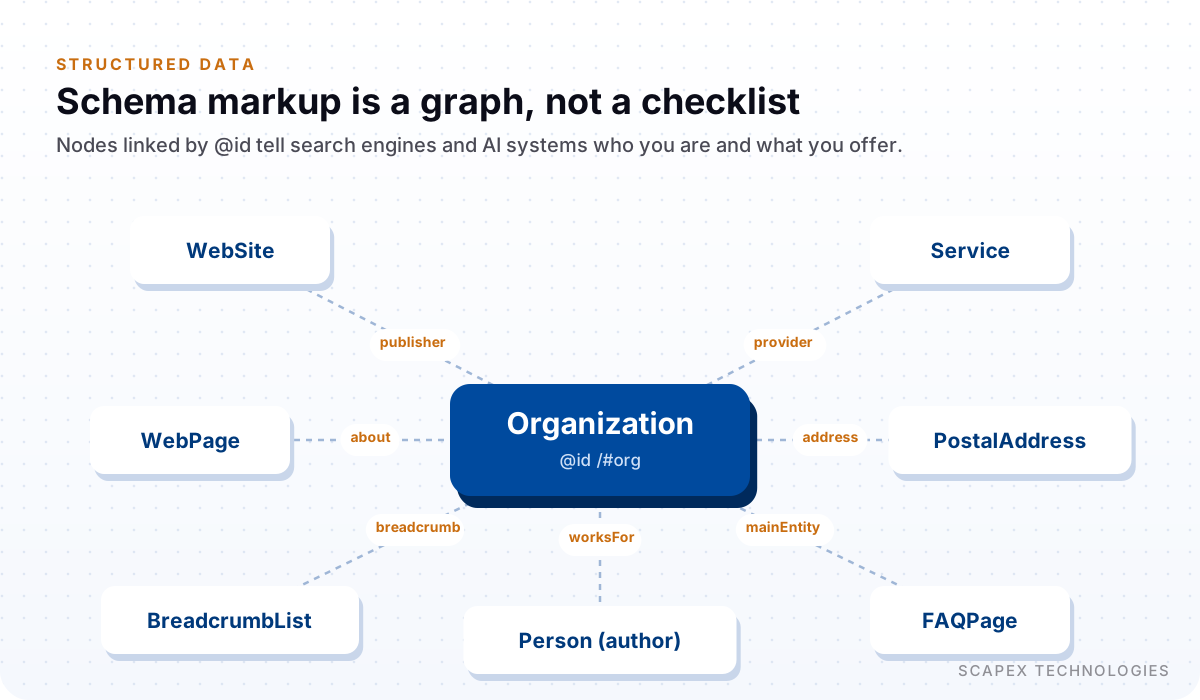
What we implement
Organization and LocalBusiness for entity clarity, which is the foundation everything else sits on. Product, Offer and AggregateRating for ecommerce. FAQPage and HowTo for answer surfaces. BreadcrumbList for navigation context. Article and BlogPosting for editorial. Service for what you sell.
Then validation against Google's Rich Results Test and the Schema.org validator — before launch, not after, because invalid markup is simply ignored and you never find out.
The mistakes we find most
Markup describing content that is not on the page, which is a guidelines violation and can earn a manual action. Multiple conflicting Organization entities across a site. Review markup on pages with no reviews. And FAQPage markup on questions nobody asked, added purely to take up more SERP space — which Google has progressively stopped rewarding.
Schema that earns something, and schema that just validates
A great deal of structured data on the web is technically valid and completely inert. It passes the testing tool, produces no rich result, and changes nothing, because it describes things no search feature consumes.
The markup worth implementing does one of two jobs. Either it powers a visual feature that exists for your page type — product with price and availability, review snippets where they are genuinely eligible, events, recipes, job postings, breadcrumbs — or it disambiguates your organisation as an entity: the same name, address, identifiers and profile links stated identically everywhere, so that search engines and assistants assembling a picture of you assemble one picture rather than three.
The second job has grown more valuable as answer engines have grown. They are building entities from scattered mentions, and explicit, consistent machine-readable facts are the cheapest way to influence what they conclude.
The most common failures are mundane. Markup that describes something not on the page, which is a guidelines violation rather than a clever trick. Aggregate ratings emitted on pages with no reviews. Two plugins writing conflicting blocks. And properties invented from memory rather than checked against the vocabulary — a property that does not exist on the type is silently ignored, or invalidates the item, and the page looks fine to everyone until somebody checks.
A hard term and an easy one, five characters apart
Measured in Semrush on 25 September 2026: “schema markup” draws 4,400 searches a month at a keyword difficulty of 79 — one of the hardest terms in technical SEO, because it is what every developer types when they need the documentation. “schema markup service” draws 170 a month in the United States at a difficulty of 15, with 110 more in the United Kingdom.
Twenty-six times less volume, and worth more. The 4,400 are looking for schema.org and Google’s structured data guidelines; almost none of them are buying. The 170 have already decided they do not want to implement it themselves.
We would rather rank for the 170. Chasing the head term would mean writing another structured-data reference that Google’s own documentation already does better, and it would bring visitors who were never going to become clients.
Common questions
Does schema markup improve rankings?
Not directly. It does not act as a ranking factor. What it does is make you eligible for rich results, clarify your entity to search engines, and give AI assistants facts they can quote safely. The click-through effect of a rich result is often larger than a one-position ranking gain would be.
Which schema types matter most?
Organization or LocalBusiness first, because entity clarity underpins everything including AI citation. Then whatever matches your content: Product for ecommerce, Service for agencies, FAQPage where you genuinely answer questions, Article for editorial.
Start with the audit
Send a URL and get a written read of your technical health, your AI-answer visibility and the three things worth fixing first.
Related